


Wind Turbine Efficiency: Formula, Cp & Betz Limit
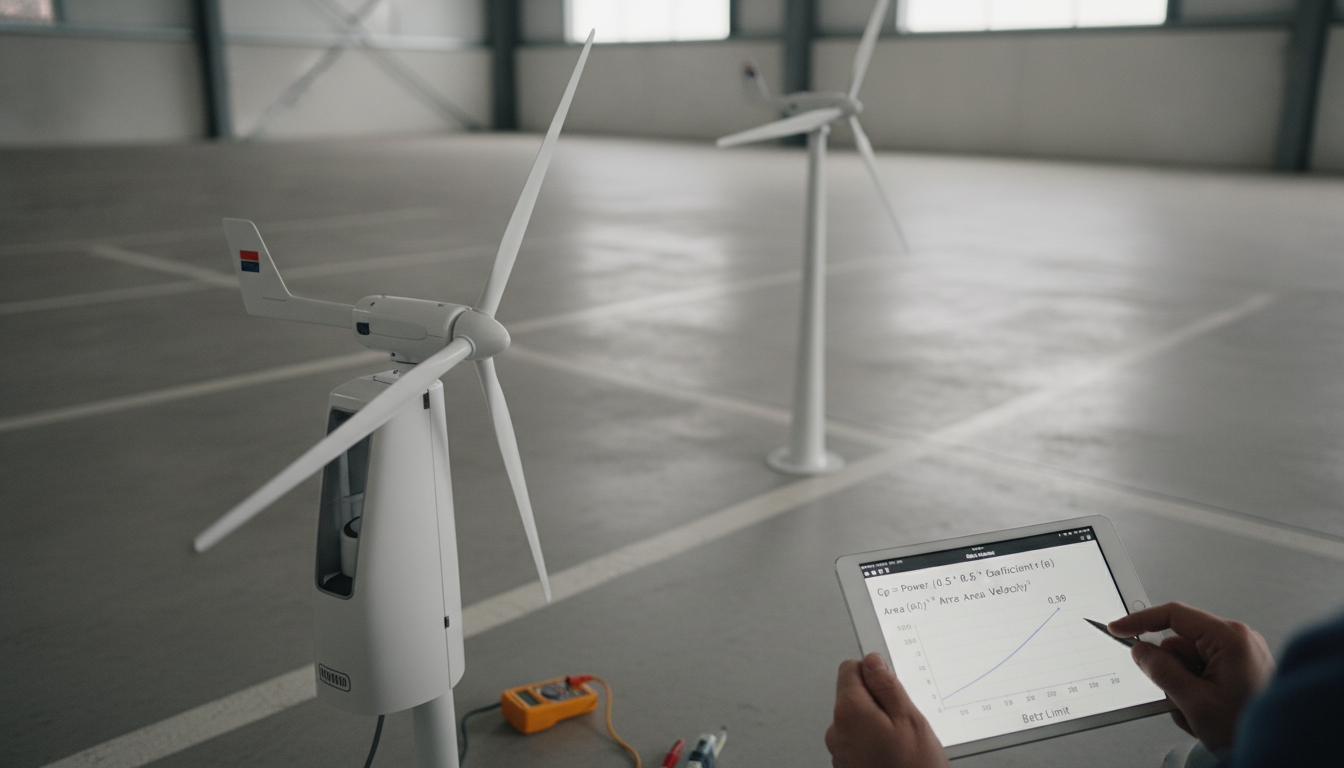
How do you calculate the efficiency of a wind turbine?
Wind turbine efficiency is calculated by comparing how much useful electrical power the turbine produces to how much power is available in the wind passing through the rotor. In practice, it’s expressed as a percentage and often discussed as a power coefficient (Cp) for the rotor, or as an overall “wire-to-wire” efficiency that includes generator and electrical losses.
Step 1: Calculate the power available in the wind
The wind’s power across the swept area is:
Pwind = 0.5 × ρ × A × v3
Where ρ is air density (kg/m³), A is the rotor swept area (m²) (A = πR²), and v is wind speed (m/s). Because wind speed is cubed, small changes in wind speed make a big difference in available power.
Step 2: Measure the turbine’s electrical output
Use the turbine’s real electrical power output at that same wind speed (typically from SCADA data, a power meter, or a tested power curve). Use watts (W) or kilowatts (kW), and keep units consistent with Pwind.
Step 3: Compute efficiency (or Cp)
Overall efficiency at a given moment is:
Efficiency (%) = (Pout ÷ Pwind) × 100
If you’re focusing on aerodynamic performance, Cp is often reported instead of a full-system efficiency. Cp uses the same ratio but refers to rotor power extraction before downstream electrical losses.
Important limits and real-world notes
No wind turbine can capture all wind energy. The Betz limit caps ideal aerodynamic capture at 59.3%, and actual operating values are lower due to blade losses, wake effects, mechanical friction, generator efficiency, inverter losses, and operation outside the best wind speeds. Also, air density changes with altitude, temperature, and pressure, so using a realistic ρ improves accuracy.
For a more detailed walkthrough, examples, and context, see the main guide: How do you calculate the efficiency of a wind turbine?
FAQ
What is the Betz limit and why does it matter for wind turbine efficiency?
The Betz limit states that an ideal wind turbine can’t capture more than 59.3% of the wind’s kinetic energy. It matters because it sets a hard upper bound on aerodynamic efficiency, even before mechanical and electrical losses are considered.














Leave a comment